Blog Disclaimer

The posts published in this blog are collected from different blogs or websites written by various famous bloggers/writers. I have just collected these posts only. These posts are not written by me. All collected posts are the great stuffs.

Blog Disclaimer

All content provided/collected on this blog is for informational purposes only, it is not used for any commercial purpose. At the end of any post, the visitor can find the link of the original source.

Blog Disclaimer

At the end of any post, the visitor can find the link of the original source. These posts are only for further reference to review/study latter. It’s a request to all visitors; please go through the original post by clicking on the source given below/above of every post.

Showing posts with label Microsoft adCenter. Show all posts

May 21, 2013

Differences between Google AdWords and Bing Ads

Due to slight differences between Google AdWords and Bing Ads, we would always recommend that you review the following four key areas before hitting the Sync button:
1.       Budgets
Bing Ads has a minimum campaign budget of £5 and a minimum bid of 5p. With Bing Ads you also have the option to choose either a Daily Accelerated, Daily Standard or Monthly Campaign Budget. You may find that traffic on Bing Ads is slightly cheaper so it may be worthwhile lowering your bids once you have imported them over
2.       Ad Text
The Bing Ads Editorial Policy and the AdWords Editorial policy will be slightly different, so we strongly recommend you review the Bing Ads policy and your imported ads before you sync your account. Your account will go through Editorial checks once you have synced. Unsure on Bing Ads Editorial Policy?
3.       Negative Keywords
Bing Ads does not support broad match negative keywords. If you are importing broad match negatives from AdWords, Bing Ads will import them as phrase match so it is important to check these before you sync. You can also use the Negative Keyword Conflict Report from the Bing Ads User Interface after a couple of weeks of account activity, to ensure that all your negatives are working as you want them to
 4.       Targeting Options
Targeting options, including location and time of day, are very different in AdWords and Bing Ads. Although we are working hard to ensure these are imported from AdWords as they should be, we strongly recommend reviewing targeting options before syncing. Please note the Import feature does not yet support postcode targeting set up on AdWords, but this can be set up separately through Bing Ads after import. When importing from AdWords you should also review your Bing Ads accounts language targeting, as once it is set and sync’d with Bing Ads this cannot be changed

Source : http://community.bingads.microsoft.com

April 17, 2013

List of Tools for PPC Advertising

Ultimate list of PPC advertising tools

The Internet is a killer place to advertise. Since 2006, the percentage of online advertising spend has grown from 6% to 13.3% of total media expense. That’s $16.9 billion to $42 billion.


There’s good reason for that. Unlike traditional advertising channels, online advertising is less expensive, far faster to market and easy to measure. Good news for you if you’re in the hot seat for getting the boss or client results. But there’s a hitch: without the right tools, you can find yourself way over your head and way over your budget.
Here’s a peek at the tools that can help you manage a successful online advertising campaign. Today’s list is limited to PPC advertising tools. Tomorrow, we’ll have an ultimate list of social media advertising tools. And soon, we’ll circle back around with display and ad network advertising tools.

Search engine PPC tools

There are few online advertising tools that can put you in front of an audience that rivals a small nation in size. But build an effective campaign with PPC on a search engine and you’ll accomplish just that. Roll that campaign across multiple search engines and in no time you’ll be a little online ad mogul.
  • Google AdWords
    With nearly 65% of search traffic, Google AdWords will get your text ads out in front of the lion’s share of search traffic. But it’s not cheap. A Sponsored Link is a coveted ad position that will drive traffic, but comes with a hefty price, too.
  • Yahoo! Search Marketing
    Out of the big three search engines, Yahoo! has the smallest market share at 14%. But it’s still a percentage you don’t want to ignore: it has the highest search success rate at 81.14%.
  • Bing AdCenter
    With two powerhouse search engines (Yahoo! and Bing) under one platform, you can interact with over 30% of search traffic, traffic that’s supposed to be known for buying, not just browsing. Sweet keyword tool.”If you do not diversify your paid search campaigns beyond Google AdWords, you’re not only missing the boat—but losing your company money via inaction.”—Loren Baker
  • Baidu Phoenix Next
    Baidu is China’s No. 1 search engine, with 75.9% of the market share in Q2 of 2011. (In comparison, Google China had about 18% of the market share during the same period.) Its advertising models and networks are similar to Google’s, but there are significant differences. Before you jump into Baidu PPC advertising, read up from experts like Gordon Choi and those at China Internet Watch.
  • Yandex.Direct
    If you want to buy PPC ads for Russian audiences, add Yandex to the list—CTR is better than Google.ru. There are some good descriptions of the tools in English, including anEnglish-language help center, but you’ll still want to read from experts like those at RussianSearchTips.com.

Google AdWords tools

Google AdWords allows you to display your ads on Google, and across its advertising network, at the moment people are searching for your product. The following tools help you leverage this powerful platform.
  • Google AdWords Keyword Tool
    When you want to find out what related word searches your ad will show on, use the Google AdWords Keyword Tool. Free and dead simple to use.
  • Google AdWords Traffic Estimator
    Google will give you rough estimates on clicks and bid prices for your ads at the top position. Helpful for planning your budget. Free.
  • Conversion Optimizer
    Google dishes out yet another AdWords tool, this time to help you achieve double-digit conversions by bidding on your CPA (cost-per-acquisition). Free, but to be eligible, campaigns must have had 15 conversions in the last 30 days.
  • AdWord Accelerator
    For a one-year subscription at $299, the AdWord Accelerator will give you access to tools like the keyword basket, estimates and competition tracking in one convenient suite.
  • Google AdWords Manager
    Raven debuted its AdWords management and reporting tools a couple of months ago. You can create AdWords campaigns, adjust budgets, pause or start campaigns in bulk, manage multiple accounts, set extensions and more. Reporting AdWords campaigns is extremely simple. $99/month for a Pro account, which gives you access to all the SEO, social media and PPC tools in the platform.
  • AdWords Wrapper
    Enter a list of keyword phrases into the Google AdWords Wrapper, click “Wrap Keywords” and bingo: you’ve got a combination of Broad, Phrase and Exact Match keywords, a combination of Phrase and Exact Match keyword, Phrase Match only keywords and Exact Match only keywords. Free.
  • Keyword Wrapper Another free tool that lets you create various combinations of your keywords. @markkennedysem says this about their service. “SEOM’s keyword wrapper is a free tool for PPC campaign managers to wrap keywords in [exact], “phrase,” and +Broad +Match +Modified match types.”
  • AdGrenade
    A super fast, super efficient way to expand your keyword list, write ads for each keyword and track each core keyword. In just six seconds. One time cost of $147.
  • AdWords Editor
    Free Google application to download your AdWords account, update your campaigns with the editing tools and then upload your changes. A must.
  • Negative Keywords Maker
    Negative keywords allow you to filter out unwanted impressions, reduce your CPC and increase ROI. But they can be a pain to create. Until now. Insert the minus sign “-” in front of keywords with one click. Free.
  • AdWords Insights
    Uncover poorly performing keywords and landing pages with low Quality Scores in bulkwith this Raven tool. Fix problems to save money and increase conversions. $99/month for a Raven Pro account, which gives you access to all the SEO, social media and PPC tools in the platform.
  • Keyword Niche Finder
    If you want to find profitable keyword niches that you can dominate, then use this free tool. You can start with general terms like “auto” or “sports” and refine until you find that keyword phrase or two no one knows about.

PPC budgeting tools

Pay-per-click advertising is probably the fastest way to dominate search engine rankings. But it can also be the most expensive. The following tools will help you manage, budget and succeed at the PPC game without breaking the bank.
  • Pay Per Click Universe
    A free resource dedicated to provide unbiased information to the small-to-medium sized business owner interested in exploring the world of PPC advertising.
  • Acquisio
    If you run multi-channel advertisements across Search, Social and Display networks, you have no shortage in the amount of data you collect. But data means nothing if you don’t turn it into action. With Acquisio, you get one integrated platform to purchase, track, manage and optimize all your marketing efforts.
  • CPC ROI Calculator
    Want a tool that figures out how you can profitably pay for your ads? This cost-per-click ROI calculator from SEOBook is just the ticket. Free.
  • PPC Bid Max
    Software solution that automatically manages your PPC campaigns. Perfect for the time-starved one-man shop. Standard edition starts at $96.
  • PPC G-Test Calculator
    This free tool allows you to predict the winner out of two competing ads, thus allowing you to save money while you optimize your ads.
  • Taguchi-based Ad Optimizer
    Want to speed up the testing process AND test up to 15 elements in your ads at a time? Then this free tool is what you need. It will blow your mind. In a good way.
  • Wordstream
    Wordstream touts its new Pause Keyword Alerts, weekly updates that tell you the keywords to pause for better campaign performance. Monthly plans for its PPC tools start at $299.

Competitive PPC analysis tools


Knowing what your competitors are doing in the online advertising space is a must if you want to dominate. These tools will help you pay attention to their campaigns and respond accordingly.
  • Spyfu
    The concept is simple: when you spy on your competitor’s AdWords campaigns you are bound to find AND capture profitable opportunities. Spyfu allows you to do this for $79 a month.
  • PPC Web Spy
    Another competitive analysis too—this time free. Uncover the Google AdWords keywords your competitors are using with Brad Cullen’s downloadable PPC tool.
  • My Ads Advertising
    In minutes you can build and customize ads, reach broad audiences or target your customers and track and monitor your ad to see how it is performing with flexible budgets and no minimum bid.
  • iSpionage
    Simply enter any domain for rich results on PPC competitors. Test it for free right from the home page, or sign up for a plan starting at $59 for more tools.
  • SEMRush
    SEMRush offers deep competitive intelligence for Google AdWords. Plans begin at $69 a month (or access SEMRush data from within Raven at no added cost.)

Your turn

What am I missing? Are there any online advertising tools out there that you think a website owner shouldn’t be caught dead without? Share your thoughts in the comments. Brutal and all.
By - Demian Farnworth

Ultimate list of Ultimate lists

Source:  http://raventools.com/blog/

February 14, 2013

Want to Transfer AdWords Accounts to Bing? Take Care of 4 Common Mistakes


Are you the one who transferred an entire Google AdWords account into Bing Ads? But do you actually manage your new Bing account? It’s now easy to copy an account from Google to Bing, but that doesn’t mean that your account will be performing the same in the Bing sponsored results.
Bing Ads is a completely different system with its own set of rules, and it is doesn’t matter how thoroughly you work inside your Google AdWords account – that won’t necessarily help you in Bing.
As a Paid Search Specialist at WordStream, I work with many accounts and I hear all the time: “Do your work on AdWords and we’ll move it to Bing when you’re all done.” Yes, that is easy but it is not the right approach to utilize the different networks. When I actually log in to Bing accounts I can see multiple mistakes which need to be improved ASAP.

Mistake #1: Screwing Up The Settings

Firstly, when you transfer an entire account you need to pay close attention to all your settings. Some features likegeo targeting, custom shapes, and audiences would be not applicable to Bing’s advertising platform. Your settings could be missed if Bing doesn’t recognize some of the AdWords features. Your ads might be shown to the entire population on every possible device in the United States or globally.

Mistake #2: Ignoring Your Bing Search Query Report

Secondly, check your Bing query report to avoid displaying for unrelated terms in Bing search. Your Bing and Google search queries could be completely different, especially when you target broad, modified broad, or phrase match types. Google AdWords is more advanced when it comes to matching advertiser’s targeted keywords, ad text, and the landing page. In most cases Google can detect when the advertiser bids on a holiday trip to Washington DC and not a book about George Washington. Bing Ads is not so advanced yet when it comes to matching queries to the right ad or landing page and some search traffic from Bing could be completely irrelevant to your business.
For example, we began to manage a client who sells lights and glow sticks for night clubs and partygoers. The client transferred his well-optimized AdWords account to Bing and left it on “autopilot.” Later on, the client logged in to Google Analytics and found a high bounce rate from Bing, indicating that people who came from a Bing search were unexcited and left the website right away.
Bing Ads Search Queries
We evaluated the Bing account and discovered that 99.9% of the traffic, everything except the branded terms, was unrelated. For example: the keyword “micro lights” brought hundreds of queries from people who searched for the Micromax smartphone, and the term “led lights” brought all different queries from people who were looking to repair their car’s headlights. It uncovers the fact that Bing does not match to landing page content and is less restrictive when it comes to broad match.
To check your search queries in Bing, go to the Reports tab, choose the “Search Query” Report Type, specific your Date Range, then click “Run.”
Bing Ads Reports

Mistake #3: Copying Mobile/Display Campaigns To Bing

Thirdly, I don’t recommend transferring your AdWords mobile and display campaigns to Bing because it can cause multiple mistakes and interruptions. They don’t work the same way on both platforms.

Mistake #4: Too Little Time Spent Optimizing Bing Ads

Besides working on your settings and queries, I also recommend doing a full evaluation of your Bing account on a monthly or quarterly basis. Microsoft is working to improve the Bing Ads system and the inside changes could involuntarily affect your account performance. By working on multiple Bing accounts, I have noticed that it is impossible to expect consistent performance from Bing. 
In addition, I recommend using WordStream software which allows you to manage AdWords and Bing Ads accounts on the same screen inside the same software platform. Our software can simultaneously apply negative keywords and make other improvements across both accounts.


Source :  Internet Marketing Software for SEO and PPC from WordStream

February 10, 2013

Most Misleading PPC Metrics


Search marketers depend on data to make decisions. Bids are raised, keywords are paused, and ad text is changed based on data. Unfortunately many decisions are being made based on metrics that portray results in a misleading fashion.
While all of the following metrics are important, when looked at individually, they can cause you to make misinformed decisions.

Impression Share

google-impressions-share-of-voice-exact
This metric is most likely one of your Google rep’s favorite. Impression share, while valuable in some cases, can provide a drastically inaccurate snapshot of your PPC campaign’s performance.
As SEM managers do their thing, keywords are paused, bids are decreased or increased,dayparting is set up all based of performance. If a set of keywords doesn’t convert well or isn’t relevant to your business, then don’t use them. When impression share is calculated it doesn’t take your optimizations efforts into an account and thus can be quite inaccurate.

Time on Site

Another metric, while valuable, that can provide an inaccurate look into your campaign performance. This metric was useful back in the ’90s when everyone was sending traffic to their homepage and expecting the user to find what they were looking for. Now this metric is becoming increasingly irrelevant with campaigns that use sitelinks to send people to the most relevant page on the site.
Analytics tools such as Google Analytics also come with some flaws related to this metric. Analytics tools often only track up into the last action taken by a site visitor and don’t accurately record how long the visitor stays on the last page of their visit. For more info on this discrepancy please check out this article.

Average CPC

Averages lie, as Melissa Mackey pointed out in an earlier SEW post. When it comes to CPCs, your “average” only tells part of the story.
For example, throughout the day your CPC is heavily affected by your competition. You may bottom out at $2.00 CPCs and spike at $100. But paying attention only to your average CPC can cause you to grossly under estimate or over estimate what you're paying per click.

Average Position

Just as an average CPC can throw you off track, your average position can do the same. A metric that is heavily dictated by your competition it is important to understand the landscape of your industry.
The numbers of competitors bidding on your keyword set, how many ads are showing in the “top” of SERPs, and other metrics need to be included when making decisions based off of average position.

Daily Budget

OK, this one isn’t a metric, but it belongs here. As many SEM managers know, Google and Bing take your daily budget caps less than seriously. In some cases, you can overspend your budget by up to 20 percent. This can be fine for someone spending $100 a day for a campaign but for someone capping out at $5,000, it can be a big difference.

Conversions Rate

Without a doubt, keeping an eye on your conversion is important. However, depending on your business model, you may be misled by this metric.
When looking at conversion rate from the 50,000 foot level, it can be a great number to show thehealth of your PPC account. But for day-to-day management, other factors such as the margin of products sold and how you value your different conversions should be the priority.
For example, let’s say you sell one product, but in three different sizes. Each size is sold at a different price and provides a different product margin. Here is the example:
conversion-rate-data
In this case, the advertiser makes a larger profit margin on the large size. If looking at conversion rate all up across the three products, it could lead you to make a poor decision. Taking the next step and granularly breaking out the data will help boost performance.

CTR

Click-through rate can be easily manipulated by an SEM manager by boosting your bid and getting your ad into the top 3 positions, using sitelinks or other ad extensions or by utilizing ad text that contains discounts or promotions (Free Shipping, 50% Off, etc.)
Decisions on keyword shouldn’t be based on CTR alone. If a keyword has a historically low CTR but converts below your target CPA and provides profit for the company, then you shouldn’t worry about CTR. Yes, you should attempt to increase your CTR, but the most important factor is how it works out financially for your business and/or client.

First Page Bids

First page bids have been a topic of contention for AdWords and me. There have been numerous times when my average position is above 3 but my bid is below the first page bid estimate. First page bid can be used as a guideline, but some simple manual bidding can help you figure out where your bid needs to be to get on the first page.

Quality Score

google-quality-scoreThere will always be a debate on how important quality score is and if you should be bidding on keywords that have a low quality score. The argument then stems to how these keywords are affecting the rest of your account.
The bottom line when it comes to quality score should beyour bottom line.
For example, as highlighted in my post about bidding on competitor terms, if the keywords convert and are profitable, then keep using them – no matter what your quality score is. Do continue to optimize and attempt to raise your quality score, but don’t make it the single factor.

Recap

All of the above mentioned metrics are important to managing you PPC efforts but they all need to be examined and weighted correctly. No single metric should be the single reason you to pause a keyword or shut down an entire ad group. Performance should be judged by multiple metrics and – ultimately – if it's profitable for your business and/or client.
By , 

Future of PPC Professional !


ou’re fired, laid-off, downsized, terminated, made redundant, rightsized, pursuing other opportunities, discharged, dismissed, pink-slipped. Search Engine Marketing professionals are becoming redundant, replaced by technology, so they should prepare themselves to hear those words.

In the next 3 years, 80% of PPC professionals will be replaced by an algorithm.

Those that won’t, will be the few who already provide high value or find ways to increase their value to clients. There will simply be fewer positions and high value change. If you are a PPC pro don’t imagine yourself immune; please read on.
What happened in other industries, automation replacing human workers is not a new story. With the speed at which technology evolves, and the vast opportunity for optimization in most accounts, PPC management is ready for this evolution and it is well under way.
Over the last several years, we audited numerous large-scale PPC advertiser accounts ($500K+ ad spend a month) and found the same common characteristic; neglect. A sad example is the story of a Top 30 Internet Retailer. Their account was managed by a super-reputable top-tier agency and had an average cost-per-click of approximately $1.50. That wouldn’t be so bad except that it brought in less than $.60 revenue per visit. The saddest part is that it was spending millions of dollars a year.
Certainly it looks like the agency you hired or your in-house PPC staffer is very busy, they legitimately are.  However, never in the history of advertising has anyone had to manage anything as complex and large as some of these accounts. The question is, how much of the business is truly high value activity? You may be seeing traffic growth, lots of bid changes, account structure and keyword changes (if you are a larger enterprise) but most of these tasks can be automated today. Plus the truth is, these are the activities that can be performed more successfully, at scale, with greater efficiency by crowdsourcing, or by using machines/ robots.
David Greenbaum, CEO of a crowdsourced ad copywriting company BoostCTR, shared:
“Ad copy optimization is one of the most straightforward paths to increasing conversions and reducing cost-per-acquisition (CPA). However, this is often an afterthought for advertisers. Typically, we see that clients are optimizing only 1 percent of their active ad groups representing 5 percent of their spend. As an extreme example, I have seen an account that spends upwards of $2 million per month and who hasn’t written a single new piece of ad copy in 3 years.”
If you are a smaller advertiser, you are less likely to have your account maintained properly by your agency. According to WordStream data, most SMB accounts had :
  • Very low number of keywords or negative keywords added in the last 90 days.
  • Very low number of ad groups and ad text added/edited or deleted in the last 90 days.
  • Very low number of campaigns added/edited or deleted in the last 90 days.
Most advertisers aren’t really taking advantage of even the most basic AdWords account optimization tools, like conversion tracking, geo-targeting, or ad extensions.
Furthermore:
  • More than 50 percent of them don’t even check their accounts once per month.
  • Almost 25 percent haven’t done anything to their account in the last 90 days.
  • More than 20 percent of them have yet to use a negative keyword and less than 50 percent have used at least one negative keyword in the last 90 days.
The highest value PPC optimization activities occur when you are testing and modifying ad copy or creating and optimizing landing pages; all critical components of Google’s Quality Score (YouTube video). Quality Score weights your bid in the auction so if your quality score is low you must pay more than another advertiser – essentially low Quality Score is a penalty imposed by Google for not optimizing.The tasks associated with optimization are traditionally the hardest to scale up. Nevertheless, solutions are beginning to appear because of big data technologies.
DataPop, offers a big data solution for automating the ad writing and optimization of your PPC ads and it is impressive. They still recommend you have a human editor for reviewing messages.
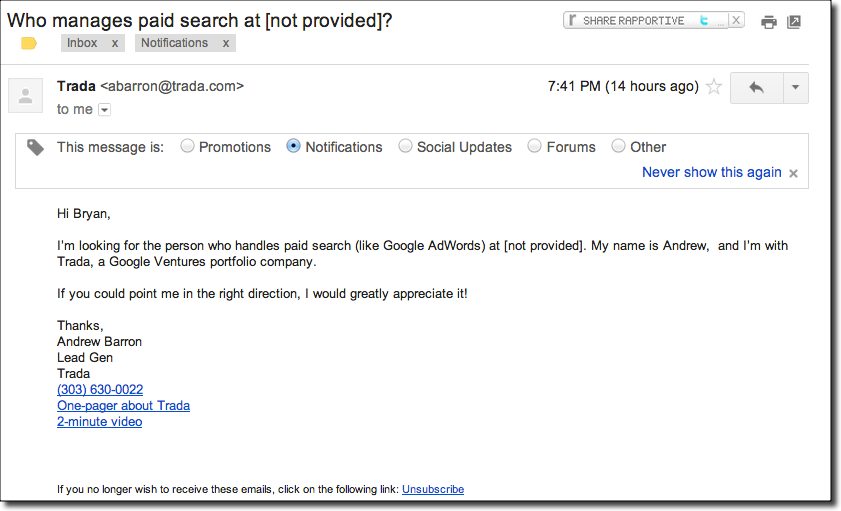
Just like should have been done with this marketing automation screw up (from a crowdsourced PPC vendor):
Trada email manage search for not provided
Here are some more ways you can take advantage of automation:
  • You can crowdsource ad writing to companies like BoostCTR. Their incentives are also more in line with advertisers’ goals than traditional agency models.
  • Monetate, will help your team test, personalize and iterate their creative ideas (leveraging big data) with greater agility than your current platform will allow.
  • For creating and optimizing landing pages, we are seeing solutions like BloomReach, that can use a natural language interpreter and big data technology to create landing pages that meet the long tail of demand and self optimize those pages as well.
Of course, these technologies don’t do everything you need in order to optimize all your landing pages.
What can’t these robots do? They may never have the creative spark or strategic capacity that humans provide. No machine today could have come up with the on the fly, Dunk in the Dark campaign that Oreo did during the SuperBowl. However, technologies like NarrativeScience and Arria are working hard to get there. Surely, Narrative Sciences will displace many of the “web analysts” who only function as data reporters without adding much business value.
We can already see that big data solutions like RocketFuel are transforming the media buying side of display advertising, removing many of the inefficiencies.
I apologize to my friends who own and work in agencies. The marketplace has changed and sometimes it is difficult to see while you have your head down. I know and appreciate how difficult and time consuming the high value work is. Also the  traditional agency compensation models for SMB might not allow the margin to spend enough time in these activities. However the PPC industry will be completely transformed over the next three years. The truth can be ugly sometimes. I hope you pay attention. We must move away from the tool junkie mentality to the customer-centric marketing mindset.
When asked my friend Tom Cunniff of Cunniff Consulting, he said the following:
“The rise of automation in marketing is both inexorable and necessary. Moment-to-moment optimization is too exhausting for humans and too expensive for marketers. Marketing automation will enable smart marketers to shift their focus from spreadsheets to the big questions. Are we optimizing for the right things? Are our digital efforts properly aligned with our overall marketing? Are customers getting what they want and need from our brands? This is marketing’s mission, and we need to get back to it.”

January 27, 2013

The 3 Key Areas About Your Paid Search Program


The smartest way to begin 2013 might well be to make a careful review of paid search performance and practices in 2012. If your company spends closer to 8 figures than 6 on paid search annually it is well worth the time of the CMO to take a deep dive here.
Evaluating an enterprise paid search program can seem a daunting task. Complexity and scale can lead senior marketing leadership to make one of four mistakes: allow paid search managers to evaluate themselves; allow a vendor seeking to win your business to evaluate your team’s performance; hire a consultant who knows little about paid search to do the evaluation; or, worst of all, evaluate performance against aspirational goals set by others. For obvious reasons, none of these yield a fair assessment of how paid search performed against opportunity.
Instead, CMOs and marketing directors should take the bull by the horns. The answers to 28 questions in 3 key areas can allow the marketing leadership to gain a better understanding of paid search, better understand the challenges and opportunities the channel presents, and get a clear picture of how well her/his team performed against that competitive landscape.
Stage 1: Goal Review
Before reviewing any data, it is important to get a clear understanding of what paid search is expected to do for your organization. This isn’t a question of what the budget or forecast was, it is much more fundamental than that. It is often remarkable how little thought goes into these questions. Deeply probing what we’re trying to accomplish and how we measure our performance against those objectives is a critical first step.
    1. What do we seek to achieve through paid search advertising? Is the goal to make money in the immediate term, short term, or long term? Is it a branding exercise? Some hybrid?
    2. Have we included in our goal setting some notion of long term value of a customer? Should we?
    3. Do we correctly separate performance of our brand keywords from competitive non-brand keywords? (This is a pass/fail question. Blended performance goals make no sense.)
    4. Have those goals changed over time? Since last year? During the course of the year? Why did the goals change?
    5. What metrics do we use to know whether we are achieving our goal? Is it a single success metric? If so, is that metric as closely tied to value as it can be?
      • In ecommerce: why use orders as a metric instead of sales, and why use sales instead of margin?
      • If leads are the success metric, do we assess the value of those leads? Do the values vary by keyword, geography or device? Do we use those differences in our bidding?
    6. How do we measure offline success driven by paid search? If we cannot measure directly, why can we not estimate it?
    7. Are there other success metrics we should use? Should not a “get directions” click or click to call on a smartphone count as some type of success?
    8. How do we address the issue of multiple paid search clicks preceding a successful visit? Do we parse credit appropriately?
    9. As a marketing team, how do we think about multiple marketing interactions preceding a successful visit (online or off)? Do we parse credit between channels? Should we?
    10. Do all of our business units follow the same practices? Is paid search managed by different teams within the organization? Does that make sense?
    11. If applicable, how do we manage international search? Do we have language skills internally to do this well? Do we advertise on Yandex (Russia) or Baidu (China)? How do we measure success of those efforts?
Stage 2: Performance Review
How did we do against the goals we pursued? Whether the goals and metrics were the right ones, whether they changed during the course of the year rightly or wrongly, the question here should be how did the paid search program do against the goals they sought? Performance shouldn’t be faulted for achieving the wrong goal.
Again, we should look at this not as a function of performance against a forecast or budget, but against opportunity. Results can be above or below forecast for reasons relating to forecasting methods and foibles, not performance. The numbers and responses in this section, and the responses in Stage 3 will get us what we want.
    1. Show me aggregated paid search performance data by month splitting out brand and non-brand.* If there are apparent deviations between the performance and the goals month-to-month, what is the explanation for those deviations? If non-brand efficiency metrics vary significantly, why would we as an organization be willing to invest more in marketing some times than we are other times?*If the goal was to achieve an aggregated performance efficiency we can’t fault the performance of non-brand advertising in isolation, but we should at least see it clearly and understand what it means. The non-brand performance is the only piece over which the paid search team has meaningful control, so that data is what must be used to evaluate performance.
    2. Show me the Year-Over-Year non-brand performance by month. What factors drove the changes year to year?
    3. Show me the trend in the fraction of total website success metrics driven by paid search. Split this out by brand and non-brand as well. Why is it trending up or down? What does that mean for the business? Does that say anything about performance?
    4. Show me non-brand performance data by month split out by search engine. If there are differences in marketing efficiency, what is the explanation?
    5. Show me Google-only performance over 2012QX {Marketing leader picks the X} broken out by category (campaign might be a decent proxy). Do the efficiency differences make sense?
    6. For a different quarter show me Google performance data by Keyword. Sort this data by advertising cost descending. Understanding that there is statistical noise involved, does the KW level performance look reasonably coherent? Do major differences in performance have a sensible explanation?
    7. Bucket this list of keywords by ranges of click volume so that there are roughly an equal number of clicks in each of 5 buckets ranging from the highest traffic terms to the lowest traffic terms. Do any performance differences between these buckets have a reasonable explanation?
There are reasonable explanations for many types of anomalies. The point of this exercise is to gain a deeper understanding of the program’s performance against goals, and to see how the paid search team answers hard questions about performance. If the answers make sense, great. If the answers smell fishy, they probably are.
Stage 3: Practice Review
Even if the performance numbers, trends and answers to the questions in stage 2 look good and sound reasonable, it is impossible to tell whether the program is truly optimized without scrutinizing the team’s practices as well. Efficient numbers could still reflect a poorly built program covered up with decent bid management.
  1. How many distinct keywords are active in our Google account? Our Bing Account? Why are those different numbers? How many distinct keywords have we tried? Why have we not tried more? Why do we turn off keywords? Couldn’t a case be made that there are no bad keywords, only bad bids? Looking through the keyword-level data in #6 above you might notice some holes; ask about them specifically and expect a reasoned response.
  2. What do we do to reduce poor quality traffic? The answer should include references to match type layers, negatives, and syndication partner treatments. Go into the account with the paid search manager and drill into a campaign and adgroups. Are there obvious negative phrases that are missing? Is the ad copy associated with each adgroup compelling but also accurately reflective of your brand? Do you see different matchtypes running for the same keyword? If so, is more being bid for the exact match traffic than broad match? If so, that’s probably a good sign, if not, it’s probably a bad sign, but another good avenue to question.
  3. While you’re in the account, navigate to a different campaign and look through the ad copy and landing page assignments. Do the keyword, copy and landing pages fit together? The landing page should reflect the specificity of the user’s query — no deeper, no shallower.
  4. Show me some examples of copy tests we’ve run in the last year. What lessons did we draw from them? What copy tests had the biggest impact on performance? Do we change copy without testing? Has that proved to be valuable? What fraction of your time goes into ad copy versus other tasks? Does that balance make sense?
  5. Do we split out campaigns by device? {Best case three separate campaigns for desktop, tablet and smartphone. Acceptable case and often just as good, two campaigns: desktop + tablet in one and smartphone in the other. Worst case is two campaigns desktop in one, tablet + smartphone in the other.} Do we have different ad copy for different devices? Do we have different objectives for different devices? Should we?
  6. Do we split out campaigns by geography? Should we?
  7. What other types of segmentation do we do to better target bids and copy?
  8. How do we set bids? {If the response involves ‘trying to find the right position’ it’s time to find a new manager.} How often do we adjust bids? Are we adjusting based on time of day and day of week? Do we have mechanisms in place to anticipate seasonal flux? Do we make use of bid simulator data to understand the cost/benefit tradeoffs of different bids?
  9. Do we make use of all the available advertising vehicles and options associated with search these days? Are we using:
    • Product Listing Ads (mostly an ecommerce option)?
    • Dynamic Search Ads?
    • Sitelinks?
    • Seller Ratings (if applicable)?
    • Search Retargeting? {This one is new but really important.}
  10. How do you prioritize activities? Do you spend most of your time on the highest leverage activities? If not, what keeps you from doing that? The answer might be that task lists from on high or demands from other constituencies in the company prevent the team from using its human resources wisely. If so, that’s important to understand, and address.
Conclusion:
This review process does not require the reviewer to have deep knowledge of paid search, the reviewer simply needs to have common sense, and a good nose for BS. Paid search makes sense when done well. Data that doesn’t make sense combined with answers that don’t make sense should raise big red flags about the health of the program.
If the practices sound right, the data makes sense given the goals and constraints placed on the team, and the team has smart, rational make-sense answers for anomalies then the team is doing its job well against the opportunity available. The right goals combined with the right practices, execution and technology will produce the best data possible.
May 2013 bring you the best results from paid search ever!


By George Michie

Source : THE RKGBLOG

Share

Twitter Delicious Facebook Digg Stumbleupon Favorites More